G’day! How is it going? We hope all is going well with you.
As cities become denser and daily life grows increasingly fast-paced, architects and landscape designers are rediscovering one of humanity’s oldest sources of healing—the forest. The integration of Forest Therapy, based on Shinrin-Yoku or “forest bathing,” into architectural landscape design has become a global movement that prioritizes human well-being alongside environmental sustainability.
Rather than simply planting more trees, today’s landscape architects are creating immersive natural environments that encourage people to slow down, engage their senses, and reconnect with nature. From hospitals and universities to urban parks and residential developments, Forest Therapy principles are transforming how outdoor spaces are designed around the world.
What Is Forest Therapy?
Originating in Japan in the early 1980s, Forest Therapy, initially known as ‘Forest Bathing‘, was developed as a public health practice that encourages people to spend mindful time in forests. Unlike hiking or outdoor exercise, Forest Therapy focuses on slowing down, breathing deeply, observing nature, and engaging all five senses.
Scientific research has shown that spending time in forest environments can provide numerous health benefits, including:
- Reduced stress hormones such as cortisol;
- Lower blood pressure;
- Improved mood and mental clarity;
- Enhanced immune system function;
- Better sleep quality;
- Increased creativity and cognitive performance.
It is scientifically proven that the ‘phytoncides’, antimicrobial organic compounds released by plants, boost our immune system when inhaled.
These findings have inspired architects and landscape designers to rethink how natural environments can become integral components of the built environment.
From Green Spaces to Healing Landscapes
Traditional landscape architecture often emphasized aesthetics and recreation. While these remain important, contemporary projects increasingly prioritize human health through evidence-based design.
Healing landscapes incorporate features that naturally reduce stress and promote restoration. These may include:
- Dense native tree canopies;
- Meandering walking paths;
- Water features that create calming natural sounds;
- Diverse plant species that stimulate the senses;
- Quiet seating areas for contemplation;
- Seasonal planting that encourages repeated visits;
- Wildlife-friendly habitats that reconnect people with local ecosystems.
Instead of simply decorating buildings with greenery, these landscapes become active participants in improving physical and psychological well-being.
International Examples of Forest Therapy in Architecture
Japan: The Birthplace of Forest Therapy
Japan remains the global leader in Forest Therapy research and implementation. Certified Forest Therapy Bases combine carefully managed woodland environments with accessible walking trails designed to maximize relaxation and sensory engagement.
Many Japanese healthcare facilities and public parks integrate surrounding forests directly into their architectural planning, allowing visitors to experience nature as part of daily life rather than as a separate destination.
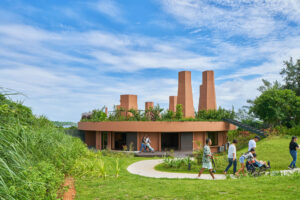
Dream for Children’s Care House by Hiroshi Nakamura & NAP, in Okinawa, Japan. Source: https://www.stirworld.com/see-features-hiroshi-nakamura-nap-s-care-house-of-the-wind-chimneys-instills-healing
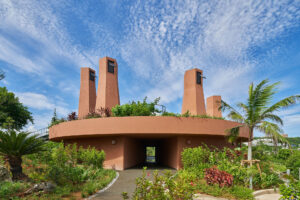
The Care House and its Wind Chimneys and rooftop garden with striking view to the surrounding landscape. Source: https://www.stirworld.com/see-features-hiroshi-nakamura-nap-s-care-house-of-the-wind-chimneys-instills-healing
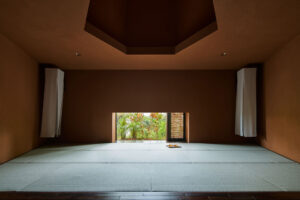
One of the Care House’s resting rooms. Source: https://www.stirworld.com/see-features-hiroshi-nakamura-nap-s-care-house-of-the-wind-chimneys-instills-healing
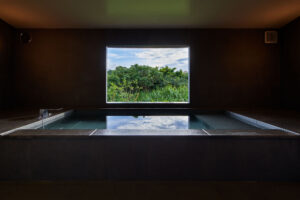
The Care House’s communal bath with a view to the natural landscape. Source: https://www.stirworld.com/see-features-hiroshi-nakamura-nap-s-care-house-of-the-wind-chimneys-instills-healing
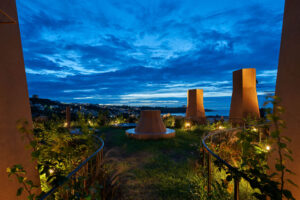
The Care House and its Wind Chimneys and rooftop garden with striking view to the surrounding landscape during dusk time. Source: https://www.stirworld.com/see-features-hiroshi-nakamura-nap-s-care-house-of-the-wind-chimneys-instills-healing
Singapore: A City in Nature
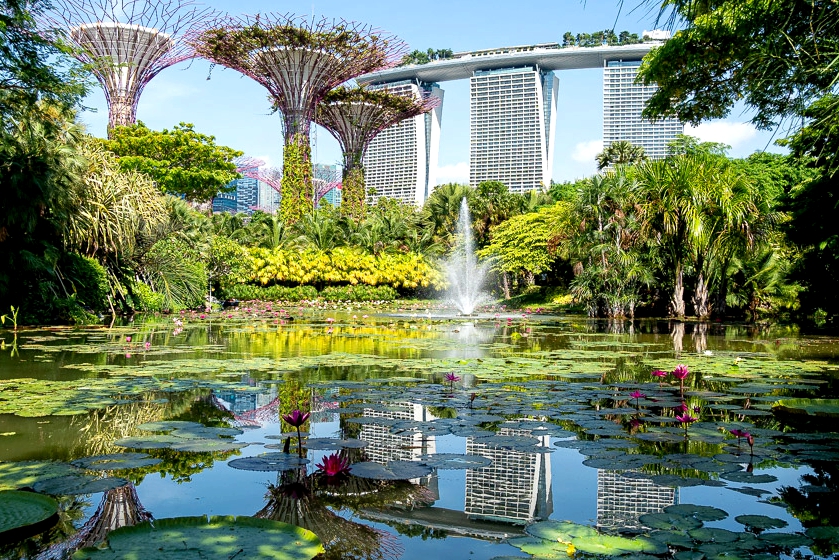
Singapore has become one of the world’s leading examples of biophilic urban planning. Rather than separating city and forest, planners intentionally weave vegetation throughout the urban fabric.
Projects such as Gardens by the Bay by Grant Associates and WilkinsonEyre, extensive park connector networks, and residential developments featuring lush planting demonstrate how architecture and landscape design can coexist with biodiversity.
Tree-lined streets, rooftop gardens, vertical forests, and interconnected green corridors allow residents to experience restorative natural environments within minutes of their homes.
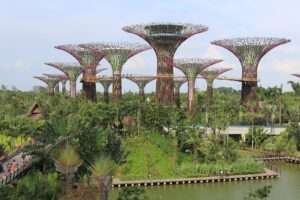
The Gardens by the Bay Urban Park in Singapore is an example of how urban planners can incorporate more greenery into cities, encouraging people to get in contact with nature in creative ways. Source: https://en.wikipedia.org/wiki/Gardens_by_the_Bay
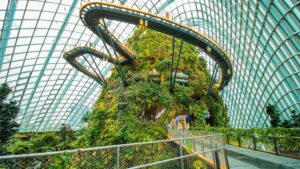
The Cloud Forest area, part of the Gardens by the Bay Urban Park in Singapore. Source: https://www.gardensbythebay.com.sg/
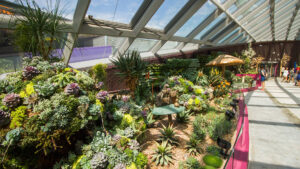
The Flower Dome area, part of the Gardens by the Bay Urban Park in Singapore, encourages people to connect to native species of flowers. Source: https://www.gardensbythebay.com.sg/
Scandinavia: Designing for Well-Being
Countries such as Sweden, Norway, Denmark, and Finland have long embraced the health benefits of spending time outdoors.
Hospitals, schools, and elder care facilities increasingly incorporate woodland gardens, outdoor classrooms, and therapeutic landscapes into their master planning. These spaces encourage year-round interaction with nature, even during colder months.
Research from Scandinavian healthcare environments suggests that access to natural views and landscaped outdoor spaces can improve patient recovery and reduce stress among healthcare workers.
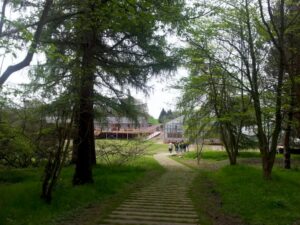
Entrance of the Therapy Garden Nacadia, in Hørsholm, Denmark. A research and treatment facility run by the University of Copenhagen. Source: https://irynaklixbull.wordpress.com/2012/07/18/therapy-garden-nacadia/
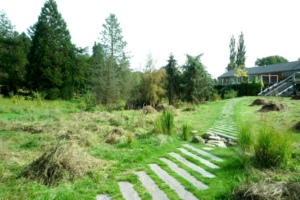
One of the meandering walking paths of the Therapy Garden Nacadia, in Denmark. Source: Sidenius, U. (2017): The Therapy Garden Nacadia® – The interplay between evidence-based health design in landscape architecture, nature-based therapy and the individual. IGN PhD Thesis August 2017.
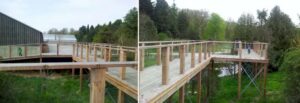
View of the surrounding trees from the wooden deck at the Therapy Garden Nacadia. Source: https://irynaklixbull.wordpress.com/2012/07/18/therapy-garden-nacadia/
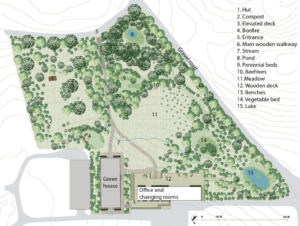
Site plan of the Therapy Garden Nacadia showings its different areas ideal for each therapeutic approach, in Denmark. Source: Sidenius, U. (2017): The Therapy Garden Nacadia® – The interplay between evidence-based health design in landscape architecture, nature-based therapy and the individual. IGN PhD Thesis August 2017.
North America: Healing Through Design
Across the United States and Canada, healthcare architecture increasingly integrates healing gardens and woodland landscapes.
Medical centers are creating accessible walking trails, meditation gardens, and restorative courtyards where patients, families, and staff can temporarily escape clinical environments.
Universities and corporate campuses are also investing in forest-inspired landscapes to support mental health, reduce burnout, and encourage creativity among students and employees.
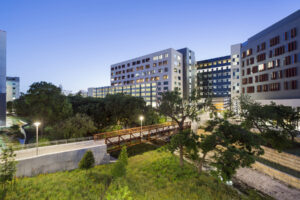
The Dell Medical School by Sasaki, part of the University of Texas campus, and its connecting gardens. Location: Austin, TX, USA. Source: https://www.sasaki.com/projects/dell-medical-district-landscape/
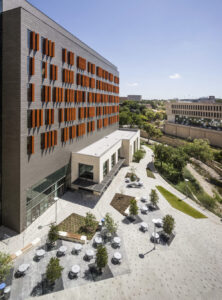
The Dell Medical School by Sasaki, part of the University of Texas campus, and its open areas. Location: Austin, TX, USA. Source: https://www.sasaki.com/projects/dell-medical-district-landscape/
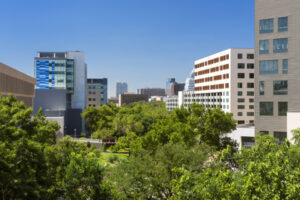
The Dell Medical School by Sasaki, part of the University of Texas campus, and its connecting gardens. Location: Austin, TX, USA. Source: https://www.sasaki.com/projects/dell-medical-district-landscape/
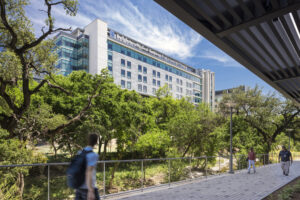
The Dell Medical School by Sasaki, part of the University of Texas campus, and its connecting gardens. Location: Austin, TX, USA. Source: https://www.sasaki.com/projects/dell-medical-district-landscape/
If you are enjoying these stunning and healing projects, don’t miss out on some of our previous Blog Posts such as ‘Modular Hospital Prototype‘, ‘Khoo Teck Puat Hospital‘, ‘Heide Museum New Healing Garden‘, and ‘Bendigo Hospital‘.
Designing for the Five Senses
One of the defining characteristics of Forest Therapy landscapes is their emphasis on sensory engagement.
Successful therapeutic landscapes consider:
Sight: Layered vegetation, seasonal color, natural patterns, and changing light.
Sound: Rustling leaves, birdsong, flowing water, and reduced urban noise.
Smell: Native flowering plants, aromatic herbs, moist soil, and forest vegetation.
Touch: Natural stone, timber seating, textured bark, soft grasses, and varied ground surfaces.
Movement: Curving pathways that encourage slow exploration rather than direct circulation.
By intentionally designing for these sensory experiences, landscape architects create spaces that support mindfulness and emotional restoration.
Sustainability Meets Human Health
Forest Therapy landscapes also contribute to broader environmental goals.
Urban forests help mitigate heat islands, improve air quality, capture stormwater, increase biodiversity, and reduce carbon emissions.
When architecture integrates healthy landscapes from the earliest design stages, projects deliver both ecological and human-centered benefits.
This dual focus makes Forest Therapy particularly relevant as cities adapt to climate challenges while addressing growing concerns around mental health and public wellness.
Conclusion
Forest Therapy demonstrates that the most powerful architectural innovations are not always technological—they are often ecological. By integrating forests, native vegetation, and immersive natural experiences into landscape design, architects create environments that nurture both people and the planet.
Around the world, successful projects show that thoughtfully designed landscapes can reduce stress, strengthen communities, enhance biodiversity, and improve overall well-being. As cities continue to grow, designing with nature will become one of the defining principles of resilient and healthy architecture for generations to come.
So, what do you think? We would love to hear your opinion on Forest Therapy integrated into urban environments and Architecture! Please leave a comment if possible. Thanks for reading our content! Cheers 🙂
Cover Image Source: https://en.wikipedia.org/wiki/Gardens_by_the_Bay
Important Sources:
https://en.wikipedia.org/wiki/Gardens_by_the_Bay
https://www.gardensbythebay.com.sg/
Therapy Garden Nacadia
https://www.stirworld.com/see-features-hiroshi-nakamura-nap-s-care-house-of-the-wind-chimneys-instills-healing
https://www.fo-society.jp/en/
What is Forest Therapy?
Sidenius, U. (2017): The Therapy Garden Nacadia® – The interplay between evidence-based health design in landscape architecture, nature-based therapy and the individual. IGN PhD Thesis August 2017.