
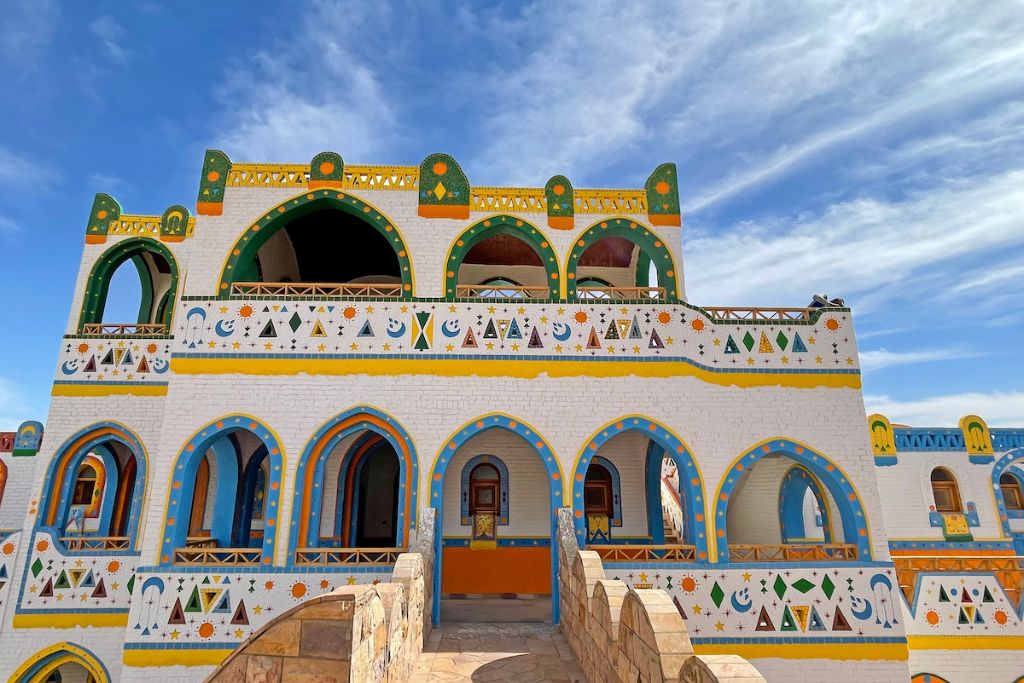
G’day! How is it going? Egypt is not only about the pyramids and large-scale mesmerising ancient temples. They also hold an ancient way of building homes.
The Nubians of southern Egypt are among the most culturally rich and architecturally distinctive peoples along the Nile Valley. Living primarily in the region surrounding Aswan and stretching historically into northern Sudan, Nubian communities have developed a unique architectural language shaped by climate, available materials, spiritual beliefs, and centuries of adaptation to life along the river. Their architecture is not only visually striking but also deeply sustainable—an increasingly relevant model in today’s world of sustainable and regenerative design.
We were recently in the Aswan region and were amazed by the simplicity and beauty of Nubian architecture. Its striking colours and openness to the natural environment are remarkable features!
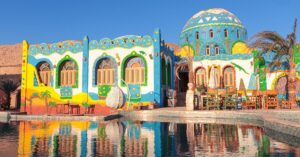
Nubian Village in Aswan, Egypt. Source: https://herasianadventures.com/nubian-village-aswan-egypt/
A Civilization Rooted in the Nile
Nubian culture dates back thousands of years, closely intertwined with ancient Egyptian civilization. The ancient region of Nubia was home to powerful kingdoms such as Kerma, Napata, and Meroë. While political boundaries have shifted over time, the Nubian identity has endured, expressed vividly through language, music, art, and especially architecture.
The construction of the Aswan High Dam in the 1960s dramatically altered Nubian life. Many communities were displaced as their ancestral lands were flooded by Lake Nasser. Despite this upheaval, Nubians rebuilt their homes in new locations, preserving traditional design elements that continue to define their architectural heritage today.
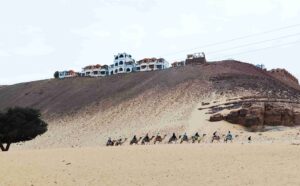
Nubian Village near Aswan seen from the margins of the Nile River. Source: The author’s archive.
The Essence of Nubian Architecture
Nubian architecture stands out for its graceful curves, domes, and vibrant decorative patterns. Unlike the rectilinear, flat-roofed structures typical in many parts of Egypt, Nubian homes often feature vaulted roofs and domes made from mudbrick. These forms are not merely aesthetic—they are highly functional in coping with the region’s intense heat.
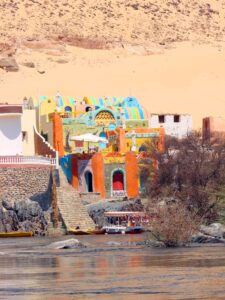
Colorful Nubian House on the margins of the Nile River. Source: https://www.egypttoursplus.com/nubian-village/
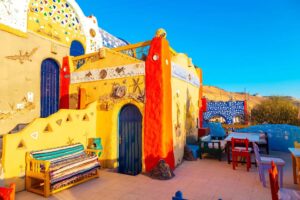
Colorful traditional Nubian village building with decorative murals. Source: https://www.egypttoursplus.com/nubian-village/
Climate-Responsive Design
Southern Egypt experiences extremely high temperatures, particularly in summer. Nubian builders developed ingenious passive cooling techniques long before modern air conditioning. Thick mudbrick walls provide thermal mass, absorbing heat during the day and releasing it slowly at night. Domed and vaulted ceilings promote natural air circulation, allowing hot air to rise and escape.
This approach aligns closely with principles of sustainable architecture and bioclimatic design. In many ways, Nubian construction techniques anticipate modern environmental strategies, making them a valuable reference for architects seeking low-energy solutions in arid climates.
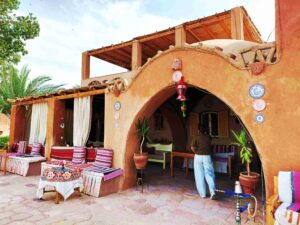
Nubian Village around the Aswan region, Egypt. Source: The author’s archive.
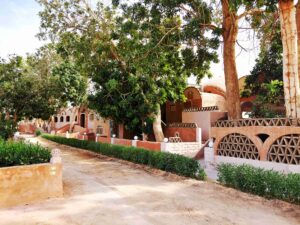
Nubian Village around the Aswan region, Egypt. Source: The author’s archive.
Materials and Construction Techniques
Traditional Nubian homes are built using locally sourced materials—primarily mud, straw, and stone. Mudbrick (adobe) is the primary building unit, formed by mixing Nile silt with organic fibers and drying it in the sun. This method is not only cost-effective but also environmentally friendly, producing minimal carbon emissions compared to industrial materials like concrete.
One of the most fascinating aspects of Nubian construction is the use of the Nubian vault. This technique allows builders to create curved roofs without the need for wooden scaffolding or formwork, which is scarce in desert environments. Bricks are laid at an angle, gradually forming a self-supporting arch. The result is a durable, elegant structure that requires minimal external resources.
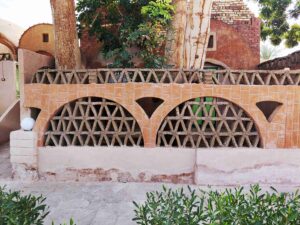
Nubian Village around the Aswan region, Egypt. Source: The author’s archive.
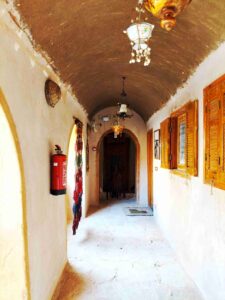
Nubian Village around the Aswan region, Egypt. Source: The author’s archive.
Color, Symbolism, and Identity
Nubian homes are renowned for their vibrant colors and intricate decorations. Exterior walls are often painted in bright shades of blue, yellow, pink, and white, reflecting both aesthetic preferences and cultural symbolism. These colors are not random—they carry meanings related to protection, spirituality, and social identity.
Geometric patterns, floral motifs, and symbolic imagery adorn doorways and facades. Some homes feature painted representations of animals, boats, or religious symbols. In many cases, these decorations tell stories about the family who lives there—marking events such as marriages, pilgrimages, or achievements.
A particularly important symbol is the use of protective motifs to ward off the “evil eye,” a belief deeply rooted in Nubian and broader Middle Eastern culture. These elements transform each house into a living canvas of cultural expression.
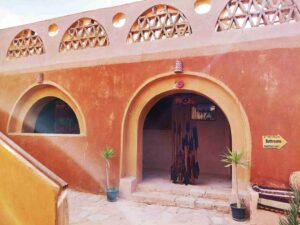
Nubian Village around the Aswan region, Egypt. Source: The author’s archive.
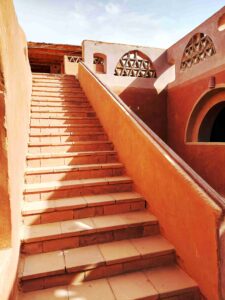
Nubian Village around the Aswan region, Egypt. Source: The author’s archive.
Spatial Organization and Community Life
Nubian homes are typically organized around a central courtyard, which serves as the heart of domestic life. This open space provides ventilation, natural light, and a private outdoor area for cooking, socializing, and family gatherings. Rooms are arranged around the courtyard, often including separate spaces for guests, reflecting the strong tradition of hospitality.
Villages themselves are designed with a sense of community in mind. Narrow streets, shared spaces, and close proximity between homes foster social interaction and mutual support. Architecture here is not just about shelter—it is about reinforcing social bonds and cultural continuity.
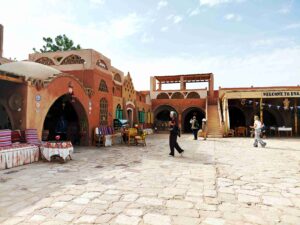
Nubian Village around the Aswan region, Egypt. Source: The author’s archive.
Revival and Global Influence
In recent decades, there has been a renewed interest in Nubian architecture, both within Egypt and internationally. Architects and designers are increasingly looking to traditional building methods for inspiration in sustainable design. The work of Egyptian architect Hassan Fathy is particularly notable. Fathy championed the use of traditional techniques, including Nubian vaults, in modern construction. His projects demonstrated that vernacular architecture could be both functional and beautiful in contemporary contexts.
Today, eco-conscious builders around the world are revisiting these methods, recognizing their potential to address climate challenges. Nubian architecture, once seen as purely regional, is now influencing global conversations about sustainability, resilience, and cultural heritage.
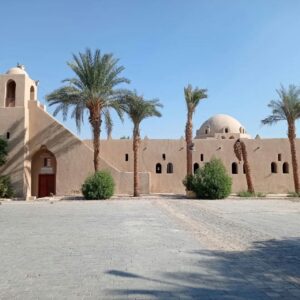
New Gourna Village (1946), Egypt, by Architect Hassan Fathy. Source: https://www.architecturelab.net/architect/famous/hassan-fathy/
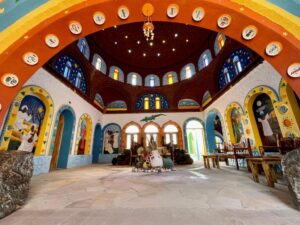
Contemporary Kato Dool Wellness Resort, in Aswan, Egypt. Source: https://www.booking.com/hotel/eg/kato-dool-nubian-house.html?aid=1607597&label=v3.cmo6awylzp1jb0874i41qk5p1
Challenges and Preservation
Despite its enduring appeal, Nubian architecture faces challenges. Modern construction materials like concrete are often seen as more durable or prestigious, leading some families to abandon traditional techniques. Additionally, economic pressures and urbanisation are reshaping rural communities, sometimes at the expense of cultural practices.
Efforts are underway to preserve Nubian heritage through documentation, education, and tourism. Cultural villages near Aswan allow visitors to experience traditional homes, while local artisans continue to pass down building knowledge to younger generations.
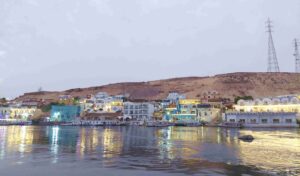
Nubian Village on the margins of the Nile River, Aswan, Egypt. Source: The author’s archive.
Conclusion
Nubian architecture is a remarkable example of how culture, environment, and ingenuity can come together to create a sustainable and meaningful built environment. Rooted in the ancient landscapes of Nubia and thriving in modern Egypt, it offers valuable lessons for the future of architecture worldwide.
At a time when the global community is searching for ways to build more sustainably, the wisdom embedded in Nubian design feels more relevant than ever. These homes—cool, colorful, and deeply connected to their surroundings—stand as a testament to human creativity and resilience along the timeless flow of the Nile.
Want to learn more about building with a more natural approach? Don’t miss our latest post about the “Ecovillages” around the world! Cheers!
Cover Image Source:
Nubian Village in Aswan: A Complete Guide to Egypt’s Most Colorful Village
Important Sources:
Hassan Fathy: Biography, Works, Awards
https://egypttoursclub.com/en/top-attractions/nubian-village-aswan-egypt-culture-colors-travel-experience
Discovering the Vibrant Nubian Villages of Aswan
Nubian Village in Aswan: A Complete Guide to Egypt’s Most Colorful Village






Comments
Elson Vinícius
Comentário